
Ear Reconstruction Surgery for Microtia
Microtia Ear Reconstruction Surgery by Dr. S. M. Balaji
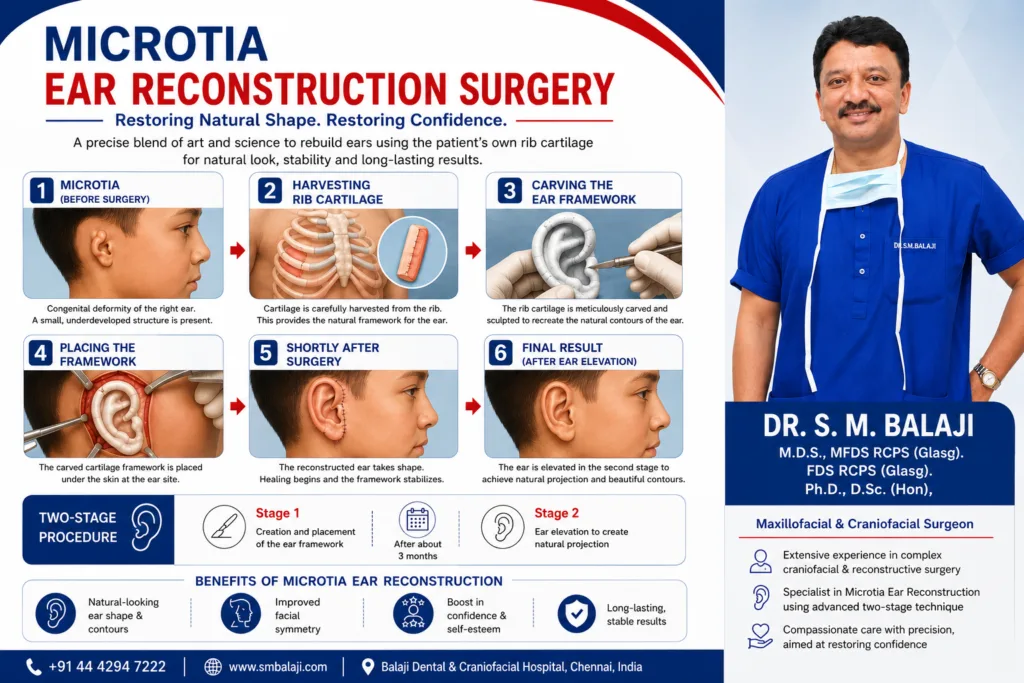
Ear reconstruction surgery is a delicate blend of art, science, surgical precision, and three-dimensional understanding of facial anatomy. Reconstructing a natural-looking external ear requires extensive expertise and meticulous attention to detail.
Dr. S. M. Balaji, a renowned maxillofacial surgeon in India, has extensive experience in the surgical management of congenital ear deformities, including microtia. His reconstructive approach focuses on creating an ear that is aesthetically harmonious with the patient’s face while restoring a natural shape, projection, and appearance.
What Is Microtia?
Microtia is a congenital condition in which the external ear does not develop normally before birth. The affected ear may be smaller than the opposite ear and can range from a mildly underdeveloped ear to the complete absence of the external ear.
Microtia may affect one ear or, less commonly, both ears. In many patients, the condition is present from birth and can be associated with other craniofacial abnormalities.
For children and adolescents, a visible ear deformity can sometimes result in unwanted attention, teasing, self-consciousness, and reduced confidence. Timely evaluation and appropriate ear reconstruction surgery can help address the physical deformity and improve facial appearance.
Microtia Ear Reconstruction: A Personalized Surgical Approach
Dr. S. M. Balaji uses a carefully planned reconstructive technique for suitable patients with microtia. The reconstruction is designed to reproduce the intricate contours of the natural ear as closely as possible.
The external ear is a highly complex three-dimensional structure. It is primarily composed of elastic cartilage, which provides the framework responsible for the ear’s characteristic curves and folds.
In selected patients, cartilage from the patient’s own rib may be harvested and carefully shaped to create an ear framework. The framework is then positioned beneath the skin at the site of the undeveloped ear.
This approach uses the patient’s own tissue and avoids some of the limitations associated with artificial ear implants.
Two-Stage Microtia Ear Reconstruction Surgery
Depending on the patient’s age, anatomy, development, and surgical requirements, ear reconstruction may be performed in stages.
Stage 1: Ear Framework Reconstruction
During the first stage, cartilage is harvested from the patient’s rib and meticulously carved and shaped to reproduce the framework of a natural ear.
The reconstructed cartilage framework is placed beneath the skin at the appropriate anatomical position. Careful planning is essential to achieve appropriate size, orientation, symmetry, and contour.
Stage 2: Ear Elevation
After the reconstructed framework has healed adequately, a second procedure may be performed to elevate the reconstructed ear.
This stage helps create the natural projection of the ear from the side of the head and improves the three-dimensional appearance of the reconstruction.
The timing between procedures is individualized according to healing and the patient’s surgical plan.
Why Use the Patient’s Own Rib Cartilage?
The reconstructed ear needs a stable framework capable of maintaining its shape over time. Autologous rib cartilage, meaning cartilage obtained from the patient’s own body, can be sculpted to create the framework of the ear.
Using the patient’s own tissue can avoid certain concerns associated with artificial materials, including foreign-body reactions and the possibility of implant-related complications.
However, every reconstructive technique has advantages and limitations. The most appropriate method depends on the individual patient’s anatomy, age, expectations, and overall treatment plan.
Microtia Before and After Ear Reconstruction
The following clinical photographs demonstrate the stages of reconstruction in an adolescent boy treated for a congenital right ear deformity.
Before Surgery
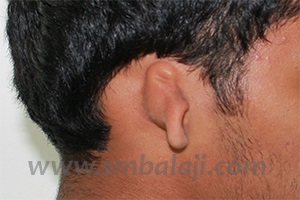
The patient was born with a deformed right external ear. Instead of a normally developed ear, only a small, underdeveloped structure was present.
Illustration: Microtia – congenital ear deformity before reconstruction surgery.
Creation of the Cartilage Framework
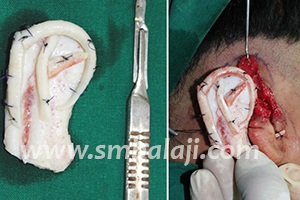
Cartilage harvested from the patient’s rib was carefully shaped and sculpted to reproduce the framework and contours of a natural external ear.
Illustration: Rib cartilage framework carefully carved and shaped for ear reconstruction.
Shortly After Reconstruction
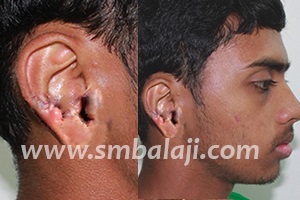
Following reconstruction, the newly created ear demonstrates the early postoperative result. Further healing and, where planned, subsequent ear elevation contribute to the final three-dimensional appearance.
Illustration: Early postoperative appearance following microtia ear reconstruction surgery.
Natural-Looking Ear Reconstruction
Successful microtia reconstruction requires more than simply creating an ear-shaped structure. The reconstructed ear must have appropriate proportions, anatomical landmarks, contours, projection, and relationship to the opposite ear and the rest of the face.
The cartilage framework is therefore carefully sculpted to reproduce important features of the external ear, including its characteristic ridges, folds, and contours.
Because every patient has different anatomy, ear reconstruction surgery is individually planned to achieve the most harmonious possible result.
When Is Microtia Surgery Performed?
The appropriate timing for microtia surgery depends on several factors, including the child’s age, physical development, rib cartilage availability, the severity of the deformity, and the reconstructive technique being considered.
Early consultation with an experienced craniofacial or maxillofacial surgeon allows the condition to be assessed and an individualized treatment plan to be developed.
Parents considering ear reconstruction surgery for a child with microtia should seek specialist evaluation rather than relying solely on age-based recommendations, as the ideal timing can vary between patients.
Benefits of Microtia Ear Reconstruction
Depending on the individual case, ear reconstruction may help:
- Recreate the appearance of a missing or underdeveloped external ear
- Improve facial symmetry and overall facial proportions
- Restore a more natural ear shape and projection
- Address the visible effects of congenital ear deformity
- Improve confidence and reduce self-consciousness associated with the deformity
The goals and expected results should always be discussed during a detailed consultation.
Frequently Asked Questions
-
What is microtia?
Microtia is a congenital deformity in which the external ear is underdeveloped or malformed. The severity can vary considerably between patients.
-
Can microtia be treated with surgery?
Yes. Depending on the patient's anatomy and individual circumstances, microtia can be treated with reconstructive surgery. Several surgical approaches are available, and the appropriate technique is determined following specialist assessment.
-
What is ear reconstruction surgery?
Ear reconstruction surgery is a procedure designed to recreate the external ear in patients who have a congenital deformity, injury, or absence of the ear. In microtia, reconstruction focuses on creating a natural-looking ear framework and appropriate projection.
-
Is rib cartilage used for ear reconstruction?
In selected patients, cartilage from the patient's own ribs can be used to create the framework of the reconstructed ear. The cartilage is carefully sculpted to reproduce the three-dimensional shape of the external ear.
-
Is microtia reconstruction performed in one operation?
The reconstruction may be performed in stages. In the technique described here, the first stage involves creation and placement of the ear framework, followed by a later procedure to elevate the reconstructed ear. The number and timing of procedures vary according to individual needs.
-
When should parents seek treatment for a child with microtia?
Parents should arrange an evaluation with an experienced craniofacial or maxillofacial surgeon to understand the available treatment options and determine appropriate timing based on the child's individual development and anatomy.
-
Expert Care for Microtia and Ear Deformities
Dr. S. M. Balaji has extensive experience in complex maxillofacial, craniofacial, and reconstructive surgery. His approach to ear reconstruction combines detailed anatomical planning, precise cartilage sculpting, and reconstructive surgical expertise.
For patients and families considering microtia ear reconstruction in India, a specialist consultation can help determine the most appropriate treatment approach and expected stages of reconstruction.