Nose Reconstruction Surgery
Advanced Nose Reconstruction Surgery by Dr. S. M. Balaji
The nose is one of the most important features contributing to facial appearance, symmetry, and overall facial harmony. A congenital nasal deformity, injury, trauma, infection, previous surgery, or loss of nasal tissue can significantly alter the shape and proportions of the face.
Nose reconstruction surgery is a specialized form of reconstructive surgery designed to restore the structure, contour, symmetry, and appearance of a deformed or damaged nose. The procedure requires a detailed understanding of the nasal anatomy, facial proportions, skin, cartilage, bone, and soft tissues.
Dr. S. M. Balaji, a specialist in maxillofacial and craniofacial surgery in India, performs complex reconstructive procedures with emphasis on anatomical precision, facial harmony, and natural-looking results.
What Is Nose Reconstruction Surgery?
Nose reconstruction surgery, also known as nasal reconstruction, is performed to rebuild or reshape the nose when its normal structure has been affected by:
- Congenital nasal deformities
- Accidental or traumatic injuries
- Loss of nasal tissue
- Previous surgical procedures
- Scarring or other acquired deformities
- Structural abnormalities affecting nasal shape
The objective is not simply to create a new shape, but to reconstruct the different anatomical components of the nose so that the result is harmonious with the patient’s facial features.
Depending on the extent of the deformity, reconstruction may involve the nasal bone, cartilage, skin, and underlying soft tissues.
Why Is the Nose Important to Facial Appearance?
The nose occupies a central position on the face and has a major influence on facial proportions. Even a relatively small alteration in its shape or position can affect the overall appearance of the face.
A nose that is significantly asymmetric, shortened, depressed, or irregular following trauma or a congenital condition may create an imbalance between the nose and surrounding facial structures.
Nasal reconstruction surgery aims to restore appropriate proportions while preserving or improving the functional and structural integrity of the nose.
The Anatomy of the Nose
The nose is a complex three-dimensional structure composed of several components working together.
These include:
Bone
The upper portion of the nose is supported by the nasal bones and surrounding facial skeleton. These structures provide stability and contribute to the overall shape of the nasal bridge.
Cartilage
The lower and middle portions of the nose contain specialized elastic cartilage that helps provide shape, flexibility, and support.
Skin and Soft Tissue
The outer covering of the nose consists of skin and soft tissues that must be carefully considered during reconstruction. Skin thickness, texture, color, and elasticity can all influence the final appearance.
Successful nasal reconstruction therefore requires careful planning of the bone, cartilage, skin, and soft-tissue envelope.
Forehead Flap for Nose Reconstruction
For patients who have significant loss of nasal skin or require extensive nasal reconstruction, a forehead flap may be an important reconstructive option.
The forehead has characteristics that can make it particularly suitable for reconstruction of the nose. Its skin can provide an appropriate tissue match for many nasal defects in terms of color, thickness, and texture.
In a forehead flap procedure, carefully planned tissue from the forehead is transferred to the nasal defect while maintaining its blood supply. The tissue is then shaped and positioned to recreate the missing portion of the nose.
Why Is a Forehead Flap Used?
A forehead flap may be considered when a substantial portion of the nasal skin is missing or severely damaged.
Potential advantages include:
- Suitable skin color and texture for nasal reconstruction
- Adequate tissue for larger nasal defects
- Ability to recreate three-dimensional nasal contours
- Preservation of vascularity through an attached blood supply
- Potential for a natural-looking reconstructive result
The choice of reconstruction depends on the size, location, depth, and cause of the nasal defect as well as the patient’s individual anatomy.
Cartilage Grafting in Nasal Reconstruction
Reconstructing the framework of the nose often requires cartilage grafting.
Depending on the patient’s needs, cartilage may be obtained from another part of the body and carefully shaped to provide structural support.
The graft may be used to:
- Rebuild or strengthen the nasal framework
- Support the nasal tip
- Reconstruct the nasal sidewalls
- Restore the nasal bridge
- Improve symmetry
- Maintain the reconstructed nasal shape
The cartilage is meticulously shaped to complement the patient’s facial anatomy and reconstruct the three-dimensional contours of the nose.
Facial Harmony and Nose Reconstruction
The appearance of the nose cannot always be considered independently from the rest of the facial skeleton.
The position of the jaws, chin, cheeks, lips, and nose all contribute to facial balance. In patients with significant skeletal discrepancies, correction of the underlying facial skeleton may be an important part of achieving overall facial harmony.
This is where orthognathic surgery, or corrective jaw surgery, can play a role in selected patients.
Nose and Orthognathic Surgery
Orthognathic surgery involves repositioning the upper jaw, lower jaw, chin, or combinations of these structures to correct skeletal discrepancies and improve facial proportions.
When the jaws are repositioned, the surrounding soft tissues—including the lips, cheeks, chin, and the tissues around the nose—can also change their position and appearance.
Therefore, in carefully selected patients, treatment planning may consider both the nasal structure and underlying facial skeleton.
Correcting the relationship between the jaws and facial structures can contribute to improved:
- Facial proportions
- Facial symmetry
- Side profile
- Chin-to-nose relationship
- Lip position
- Overall facial harmony
However, orthognathic surgery is not a treatment for every nasal deformity. It is considered when an underlying jaw or skeletal discrepancy contributes to the patient’s facial imbalance.
Comprehensive Facial Reconstruction
Complex facial deformities may require a multidisciplinary and staged approach. Depending on the condition, treatment can involve a combination of:
Nasal reconstruction + cartilage grafting + soft-tissue reconstruction + corrective jaw surgery + craniofacial reconstruction
Each patient’s treatment plan is individually designed after detailed clinical examination and assessment of the facial skeleton and soft tissues.
The goal is to achieve a result that looks natural, proportionate, and harmonious with the patient’s existing facial features.
Who May Benefit From Nose Reconstruction Surgery?
Nose reconstruction may be considered for patients with:
- Congenital nose deformities
- Nasal deformities following accidents or trauma
- Partial or complete loss of nasal tissue
- Significant nasal asymmetry
- Nasal scarring and tissue defects
- Structural nasal abnormalities
- Complex craniofacial deformities
- Previous surgery resulting in significant tissue or structural loss
A specialist consultation is essential to determine whether reconstruction is appropriate and which technique is most suitable.
Why Choose Dr. S. M. Balaji for Complex Nasal Reconstruction?
Dr. S. M. Balaji brings extensive experience in maxillofacial, craniofacial, and reconstructive surgery. Complex nasal reconstruction requires meticulous planning because the surgeon must consider both the functional and aesthetic aspects of the nose.
His reconstructive approach focuses on:
- Detailed facial and skeletal assessment
- Three-dimensional surgical planning
- Precise cartilage and tissue reconstruction
- Restoration of nasal symmetry and proportions
- Integration of the nose with the overall facial appearance
- Individualized treatment planning
Case 1
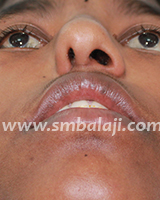
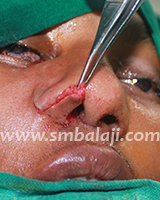
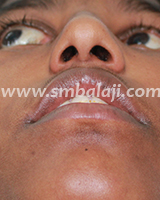
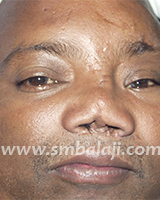
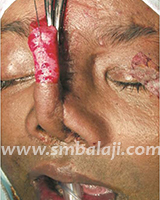
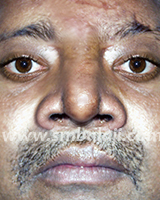
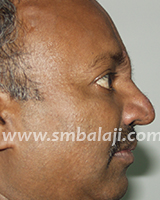
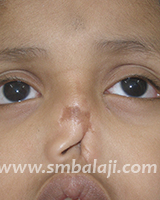
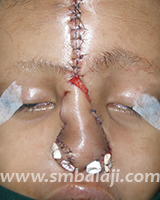
This reconstruction is a surgical procedure in which a graft consisting of a section of the skin along with blood vessels is lifted from the forehead region with the base of the graft still attached to the forehead in between the eyebrows. The wound on the forehead is sutured. The graft is then brought downwards and attached to the nose tip.
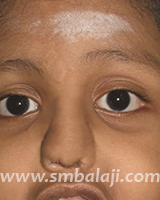
After blood supply is established in the nose, the graft tissue is cut off from the forehead. With this reconstruction, there is no color mismatch and it gives the nose a more normal appearance. Along with this if required, cartilage grafts from the ribs can be taken to reconstruct the side or central prominence of the nose. The type of reconstructive surgery required will depend on the extent of deformity of the nose.

Case 2
The photographs of a 7-year-old boy show how the nose injured in an accident was reconstructed using a graft from the forehead. The sharpness of the nose and nose tip is accurately reconstructed to give a more natural form and appearance. The photographs of a 20-year-old girl show how the shape of the nostrils was deformed since birth. The side of the nose is rebuilt giving a more normal structure and appearance.
Case 2
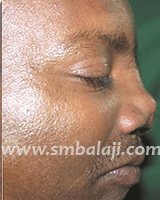
A social worker and human rights activist was referred to Balaji Dental and Craniofacial Hospital for specialized reconstructive surgery of the nose. His work involved him to interact with many people from different walks of life. In one such encounter, during a civil unrest, a miscreant bit his nose. After initial first aid treatment, he was referred here for expert care.