
Unilateral Cleft Lip & Palate Rhinoplasty Surgery
Patient presents to our hospital for nose asymmetry correction The patient is a young man who had undergone cleft surgery in our hospital as an infant. He now presents for correction of nasal asymmetry and scar revision surgery. Treatment planning explained in detail to the patient Dr SM Balaji examined the patient and explained the treatment planning to him. He explained that harvesting a rib graft was necessary for this surgery. The patient consented to this and agreed to the surgery. Successful rhinoplasty and cleft lip scar revision surgery Under general anesthesia, a rib graft was first harvested from the patient. A Valsalva maneuver was then performed and demonstrated a patent thoracic cavity. The incision was then closed in layers. Attention was next turned to the rhinoplasty surgery. Intranasal incisions ensured absence of visible scar formation. Medial osteotomy of the nasal bone was then done. The spreader graft was then placed. Following this, the rib graft was then shaped and tunneled to the bridge of the nose. This established symmetry of the nose. Attention was next turned to the scar from the previous cleft lip surgery. The scar was then incised and skin edges sutured using fine sutures. The patient expressed his satisfaction at the results before final discharge. Surgery Video
Deviated nose correction with cc graft
This is a 30-year-old male from Belagavi. He was involved in a road traffic accident. This resulted in a blocked nose with difficulty breathing. He had undergone a nose block clearance surgery elsewhere by open rhinoplasty. This resulted in him developing a deviated nose. There was also residual scars over the bridge of the nose and the columella. He was very dissatisfied with this and desired corrective surgery. He searched the Internet for the best nose deformity correction surgeon. This led him straight to our hospital. Dr SM Balaji examined the patient. The patient explained his problem. He said he had great difficulty breathing and that he wished for a more prominent nose. He agreed to the proposed treatment plan. Surgical correction would be through the use of a costochondral rib graft. The nasal deviation was first corrected by a right lateral osteotomy. The nasal bridge height was then increased. This was by using the graft harvested from the right inframammary region. A small piece of the tissue was next excised from the right supra-alar crease to lift up the right nostril. The results were immediate and the patient was very satisfied with the results. He expressed his gratitude before discharge from the hospital.
Cosmetic Rhinoplasty – Nasal Bridge Augmentation & Alar Base Reduction Surgery
Searching for the best rhinoplasty surgeon in India The patient is a young woman who always wanted a sharp nose with a straight bridge. She had always felt that her nostrils were too wide for her face. A doctor in her hometown suggested that she undergo rhinoplasty. She and her parents searched for the best rhinoplasty surgeon in India. They finally decided to come to our hospital for surgery. Treatment plan explained to the patient Dr SM Balaji, Rhinoplasty specialist, examined the patient upon arrival at the hospital. He explained to the patient and her parents that she needed a rib graft. The patient and her parents were in agreement with the treatment plan proposed by him. Rhinoplasty procedure performed on the patient Under adequate general anesthesia, a rib graft was first obtained from the patient. A Valsalva test was then performed to confirm that there was no perforation of the thorax. Attention was next turned to the nose. An intranasal incision ensure that there would be no external scar formation. The bone graft was then tunnelled through the incision to lift up the bridge of the nose. Alar reduction was then performed to reduce the width of the patient’s nostrils. The patient and her parents expressed their happiness at the results of the surgery.
Rhinoplasty – Depressed Nasal Bridge Elevation Surgery
The patient desires to undergo rhinoplasty surgery The patient is a young woman who has a depressed bridge of nose. She has never been happy with her nose. The patient had undergone maxillary osteotomy elsewhere a few years ago. Her surgeon at that hospital had expressed inability to perform nasal correction. She had searched for the best rhinoplasty surgeon in India. This had led her straight to Balaji Dental and Craniofacial Hospital, Teynampet, Chennai. Treatment plan for rhinoplasty explained to patient Dr SM Balaji, nose correction specialist, examined the patient. He then ordered imaging studies for the patient. The patient still had retained plates and screws from her old osteotomy surgery. Dr. Balaji explained the treatment plan to the patient and her parents and they were in agreement. Rhinoplasty surgery Under general anesthesia, two cartilaginous rib grafts were first harvested from the patient. Valsalva maneuver demonstrated absence of perforation into the thoracic cavity. The incision was then closed in layers. Attention was next turned to the retained hardware from the old surgery. The hardware was first removed through a maxillary vestibular incision. The incision was then closed with sutures. Attention was then turned to the nose. Intranasal incisions were then made. Lower nasal thirds of the alar cartilage was next excised and removed. The cartilaginous grafts were then inserted through the incision. This was then tunneled up to the bridge of the nose. The tip of the nose was next lifted up with the aid of a cartilaginous graft. This resulted in the patient getting a straight bridge of the nose with a nice nasal tip. The patient expressed satisfaction at the results of the surgery. She was then discharged from the hospital. Surgery Video
Paediatric (Child) Rhinoplasty Surgery with Costal Cartilage
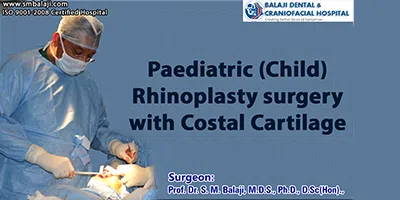
The patient had a collapsed tip of nose at birth. This particular defect would under normal circumstances be repaired only at a much later stage, but this particular child was being picked on and mocked constantly at school by other children. This distressed the child to a degree that it was affecting her emotional and psychological health. The parents of the child were distressed upon seeing this and approached Dr. S. M. Balaji, Craniofacial Surgeon, Chennai, who upon hearing about the child’s plight decided to perform the surgery on humanitarian grounds. A costal cartilage graft was first harvested from the right rib cage and the wound was subsequently closed in layers. Following this, the costal cartilage was molded and shaped for graft placement to augment the tip of the nose. The costal cartilage graft was tunneled along the base of the nasal septum until it approximated the collapsed tip of the nose. Once normal nasal tip anatomy had been reestablished by proper positioning of the graft and normal profile of the nose had been regained, the graft was sutured in place. Following this, the intraoral incision was sutured and closed. Secondary corrections might be needed at a later stage. The patient and her parents were extremely pleased with the aesthetic results of the surgery.
Re-alveolar bone graft Surgery, Fistula Closure and Cleft Rhinoplasty Surgery
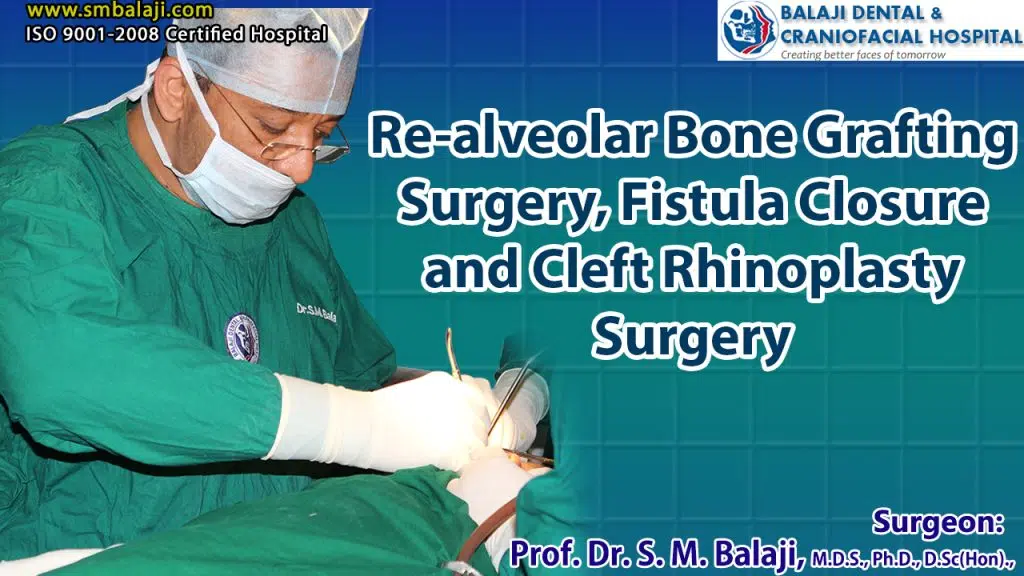
[et_pb_section fb_built=”1″ _builder_version=”3.22″][et_pb_row _builder_version=”3.25″ background_size=”initial” background_position=”top_left” background_repeat=”repeat”][et_pb_column type=”4_4″ _builder_version=”3.25″ custom_padding=”|||” custom_padding__hover=”|||”][et_pb_text _builder_version=”3.27.4″ background_size=”initial” background_position=”top_left” background_repeat=”repeat”]This young girl had been born with a left-sided cleft lip, alveolus, and palate. She had undergone repair of her cleft lip as an infant with an alveolar rib graft, but the graft hadn’t fused with the bone and had been a failure. She had developed an asymmetry of her nose because of this and a deficiency in the development of the cartilaginous part of her columella, which had lead to a collapsed left nostril. This had made her very quiet and withdrawn, isolating herself from her peers at school. The alveolar cleft in the region of her left lateral incisor was causing a direct communication with her nasal cavity through an oronasal fistula, which was leading to regurgitation of fluids from her mouth into her nasal cavity. Her parents had been enquiring everywhere as to where her defect would be best set right and had finally been referred to Balaji Dental and Craniofacial Hospital, Teynampet, Chennai. Dr. S. M. Balaji, Cranio-Maxillofacial Surgeon, examined the patient thoroughly and ordered comprehensive imaging studies including a 3D axial CT scan. He then explained the treatment plan in detail to the parents of the patient and they expressed their desire to go ahead with surgery. After satisfactory induction of general anesthesia, two costochondral rib grafts were obtained from the patient. The wound was then closed in layers after ascertaining patency of the pleural cavity through the positive pressure ventilation test. Following this, mucogingival and palatal flaps were raised on the left side of the patient’s maxillary region at the region of the alveolar cleft defect. Costochondral rib grafts were shaped and crafted to fit into the area of bony defect and fixed with screws. Attention was next turned to the collapsed columella. A costochondral rib graft that had been shaped to precisely fit into the columella was inserted along the length of its base and stabilized in place with sutures. This lifted up the collapsed columella of the nose and set right the deformity to the left nostril. The palatal and the mucogingival flaps were then closed with sutures and the patient recovered uneventfully from general anesthesia. The patient expressed her happiness to Dr. Balaji for setting right the deformity to her nose and her parents expressed their gratitude to Dr. Balaji for enabling an improvement in the aesthetic as well as functional quality of life for the patient. [/et_pb_text][et_pb_video src=”https://www.youtube.com/watch?v=ufiBluI_hic” _builder_version=”4.9.4″ _module_preset=”default”][/et_pb_video][/et_pb_column][/et_pb_row][/et_pb_section]